Why a $7 VPS AI agent on IRC is getting real attention right now
If you only saw the headline, this looks like another fun hacker demo. After reading the original write-up and the Hacker News thread, I think the real reason people are paying attention is simpler: it shows how small an agent stack can get before it starts feeling practical.
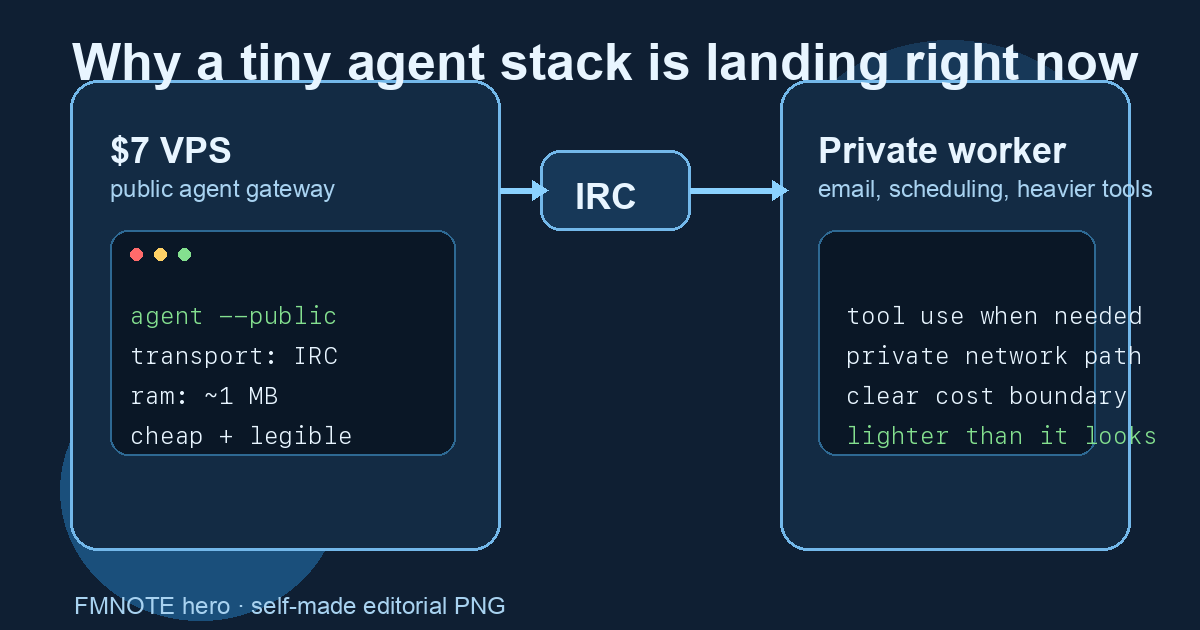
The project is called nullclaw. The public side runs on a cheap VPS, uses IRC as the transport layer, and keeps the footprint intentionally small. The private side handles scheduling and email separately. That split is what makes the demo feel less like a toy and more like a pattern other teams could borrow.
What is actually new here?
The official write-up is not claiming some huge model breakthrough. The interesting part is the system design. The public agent is presented as a lightweight gateway that can stay cheap, respond fast, and hand off heavier work only when needed. In the Hacker News discussion, that tradeoff seems to be what resonated most. People were not reacting to raw benchmark claims. They were reacting to the idea that agent infrastructure does not always need a heavy web app, a bigger cloud bill, and another layer of orchestration just to feel useful.
That matters right now because a lot of AI tooling still assumes the opposite. The default pattern is often a bigger stack, more moving parts, and a much fuzzier cost model. This project goes in the other direction. It keeps the public surface area narrow, uses a familiar transport, and makes the cost boundary explicit.
Why the HN reaction makes sense
There are at least three reasons this landed well with the crowd that usually ignores generic AI demos.
First, the cost framing is concrete. A cheap VPS is easy to picture. People immediately understand what a low monthly floor means, even if their real production setup would be more expensive.
Second, the architecture has a clear boundary between public interaction and private automation. That is easier to reason about than the usual “one smart agent does everything” pitch.
Third, the transport choice is opinionated enough to be memorable. IRC is not the point by itself, but it makes the broader argument obvious: a useful agent does not need to arrive in the most fashionable wrapper.
What teams should actually take from it
I would not read this as “everyone should put agents on IRC.” That is the wrong lesson. The more useful takeaway is that lightweight interfaces and hard cost boundaries still matter, especially when teams are moving from prototype mode into something they might keep running.
If you are evaluating internal agents right now, this is the practical angle worth watching: can the public-facing piece stay small and cheap while private jobs, tools, and approvals stay isolated? That pattern travels much better than the IRC detail itself.
There is also a second-order lesson here. Community attention is starting to reward AI projects that explain operational shape clearly. Not just model choice. Not just vibe. Readers want to know what runs where, what stays private, what costs money, and what breaks first. This project gives enough of that structure for people to debate the design instead of hand-waving around “agentic” language.
Where I would stay skeptical
The post is still a creator write-up, and that matters. A compact demo can look cleaner than the maintenance reality. Reliability, abuse handling, monitoring, and long-term ergonomics are where a lot of lightweight systems get less charming. The public/private split is smart, but it does not remove the need for operational discipline.
That is why I think this story is worth reading as a signal, not as a finished template. The signal is that people are hungry for agent systems that feel legible and cheap enough to experiment with. The exact implementation is less important than the fact that the conversation moved away from “which frontier model won today” and toward “what kind of agent stack is actually sane to run.”
The short version
This is getting attention because it shrinks the agent conversation down to something concrete: a small public interface, a separate private worker, and a cost story people can understand at a glance. Even if you never touch IRC, that combination is a more useful pattern than most AI launch posts manage to show.
Last checked: 2026-03-28
Sources: